1. The Critical Imperative for Synthetic Test Data in Modern Software Engineering
In contemporary cloud-native software engineering, automated quality assurance (QA), and continuous integration pipelines (CI/CD), realistic test data is an absolute prerequisite. For decades, software teams relied on static, hardcoded placeholder data—such as "John Doe" residing at "123 Main Street, Anytown, USA"—or copied raw production customer databases into local staging servers. However, both of these legacy practices have become completely indefensible in modern enterprise development.
Trivial placeholder data fails to surface real-world edge cases: it cannot evaluate multi-byte character encodings, international postal code formatting discrepancies, or regional administrative boundaries. Conversely, using production customer data in non-production environments introduces severe regulatory hazards. Global legal frameworks—most notably the European Union General Data Protection Regulation (GDPR), the California Consumer Privacy Act (CCPA/CPRA), the Brazilian General Data Protection Law (LGPD), and the Health Insurance Portability and Accountability Act (HIPAA)—impose severe financial penalties on organizations that expose personally identifiable information (PII) to staging environments or unauthorized testing personnel.
Synthetic identity synthesis solves this engineering dichotomy. By programmatically generating mathematically coherent personas—complete with culturally authentic names, structurally accurate postal codes, realistic physical street locations, and Luhn-valid payment sandbox tokens—engineering teams can thoroughly validate international checkout funnels, identity verification pipelines, and database ingestion workflows without touching a single byte of real customer PII.
2. Spatial Mechanics of Global Address Generation and Geocoding Envelopes
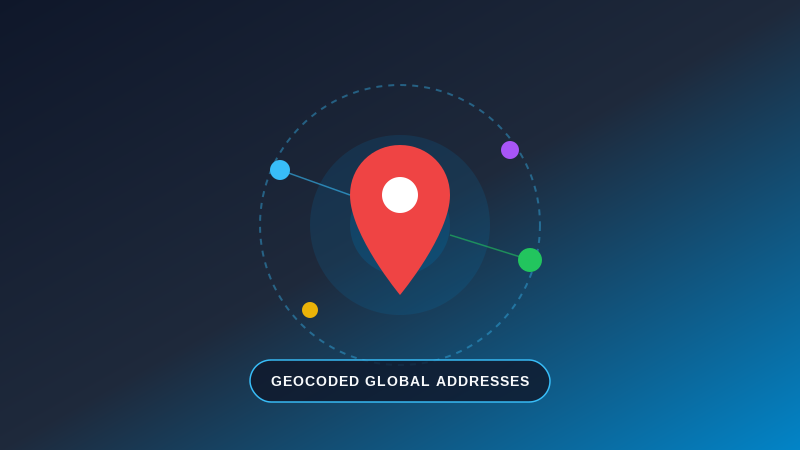
A physical address is vastly more complex than a generic string of text. International addresses represent geographic spatial entities anchored within sovereign territorial boundaries, national postal logistics grids, and localized administrative hierarchies. Our platform implements an authoritative dual-engine geocoding architecture that models the genuine spatial reality of 133 sovereign countries:
- Enterprise Satellite Geocoding Engine: Operates by dynamically querying verified international geographic coordinate databases. It projects bounding boxes across authentic metropolitan zones, rural districts, and postal centers, extracting genuine public street alignments and geographic centroids without linking to residential occupant records.
- High-Entropy Local Offline Matrix: For maximum execution velocity, our platform incorporates a localized repository of over 100,000 international administrative units. The engine strictly respects jurisdictional boundaries: when synthesizing an address in Sydney, Australia, it binds the street to the State of New South Wales and validates the postal code within the strict 2000–2234 Australian Post code range.
To calculate geodesic distances between synthesized points of interest or simulate delivery route dispatch algorithms, the platform utilizes the mathematical Haversine formula, ensuring accurate spatial calculations over spherical coordinates:
3. Algorithmic Rigor: Luhn (Modulus 10) Checksums & Financial Token Validation
Financial technology (FinTech) applications, subscription billing engines, and e-commerce shopping carts require payment card inputs that pass syntactic validation before initiating transaction processing. A random string of 16 digits will be immediately rejected by client-side checkout scripts, breaking automated end-to-end tests.
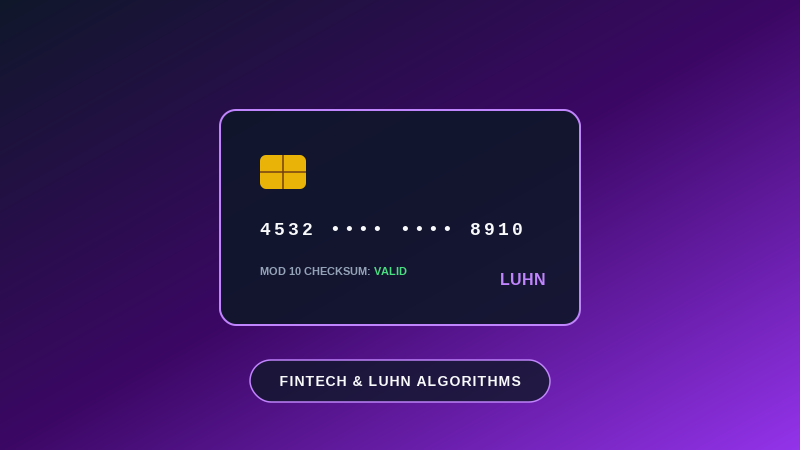
Our synthetic identity generator calculates payment tokens using the standardized Luhn Algorithm (ISO/IEC 7812-1). The Luhn algorithm operates by doubling the value of every second digit from the rightmost position and summing all digits. The calculated check digit satisfies the congruence equation:
Every synthetic card is mapped to authoritative Issuer Identification Number (IIN) prefixes: Visa cards begin with 4, Mastercard cards adhere to ranges 51–55 or 2221–2720, and American Express cards adhere to 34 or 37 with 15-digit card formats. These numbers pass all front-end form validation filters in developer test modes (such as Stripe, Braintree, Adyen, and PayPal sandboxes) while remaining completely safe from unauthorized monetary processing.
4. The Zero-Collision SHA-256 Anti-Repeat Ledger
A fatal flaw in simplistic pseudo-random mock libraries is unintentional duplication. Under the statistical principles of the Birthday Paradox, drawing randomly from a finite entropy pool results in rapid key collisions. In an automated test suite attempting to seed 50,000 unique records into a relational database enforcing unique SQL constraints (`UNIQUE(email)` or `UNIQUE(identity_hash)`), a single collision aborts the entire database transaction.
To guarantee absolute mathematical uniqueness, our system passes every generated identity through a SHA-256 Anti-Repeat Ledger. The engine synthesizes a canonical composite tuple comprising:
The resulting 256-bit hexadecimal digest is checked against both an ultra-fast in-memory Bloom filter ($O(1)$ lookup time) and a persistent SQL ledger table. If a duplicate hash is detected, the internal entropy state is incremented and an alternative identity is instantly produced, providing enterprise developers with guaranteed 100% collision-free test batches across runs exceeding 100,000+ consecutive generations.
5. Internationalization (i18n), Multilingual Demographics & Character Encodings
True international testing demands rigorous demographic authenticity. A generator that merely attaches Western first names to international addresses creates artificial personas that fail automated fraud detection algorithms and natural language processing (NLP) pipelines. Our data science architecture incorporates authentic census demographic frequency distributions across 133+ nations:
- Slavic & Eastern European Inflections: Grammatical gender concordance automatically adjusts patronymic surnames (e.g., masculine "Ivanov" vs feminine "Ivanova").
- Hispanic & Ibero-American Naming: Accurate modeling of dual paternal and maternal family surnames (e.g., "García Márquez").
- East Asian Onomastics: Proper surname-first formatting for Japanese, Chinese, Korean, and Vietnamese personas.
- Unicode UTF-8 Integrity: Complete preservation of multi-byte characters, umlauts (ä, ö, ü), acute accents (é, ó), cedillas (ç), and non-Latin scripts (Cyrillic, Kanji, Hangul, Arabic).
6. Step-by-Step CI/CD Automation & Testing Framework Integration
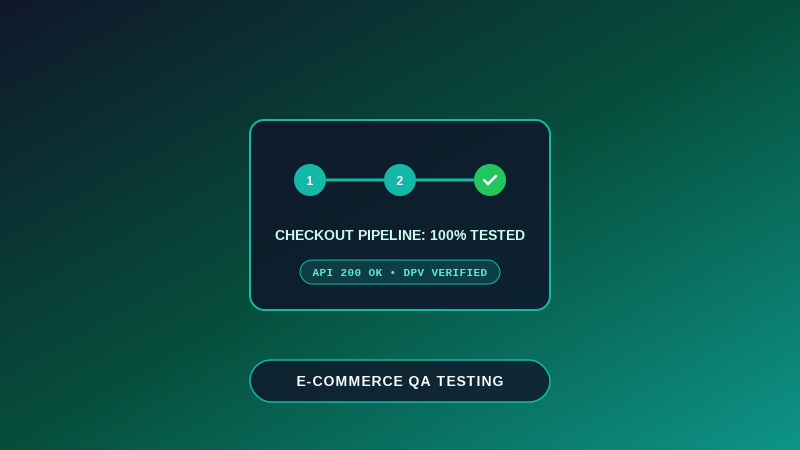
Modern agile engineering organizations integrate synthetic identity generation directly into their continuous integration workflows. Whether executing end-to-end browser tests in Cypress or Playwright, running load simulations in k6 or Locust, or populating staging databases in Laravel, Django, or Ruby on Rails, our lightweight REST API delivers structured JSON payloads at microsecond latency:
// Fetch 10 authentic German test personas with a single HTTP request

            GET /api.php?action=bulk_generate&country=DE&count=10
By decoupling test data generation from static database snapshots, engineering teams eliminate flaky test executions caused by database state drift, ensure 100% compliance with international data privacy laws, and empower developers to ship resilient, globally compliant software with maximum confidence.